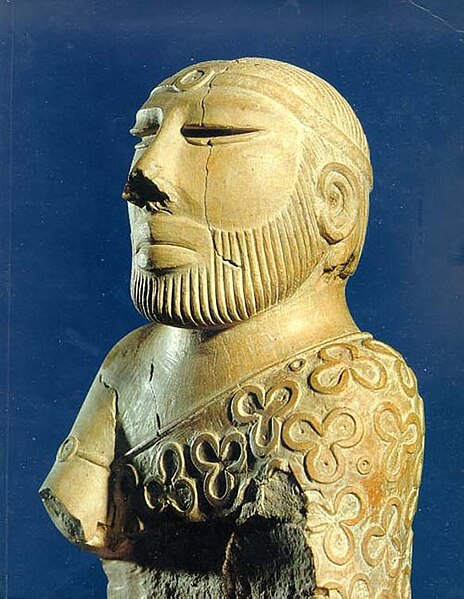
The Bronze Age in the Indian subcontinent began around 3300 BCE with the early Indus Valley Civilization. It was centered on the Indus River and its tributaries which extended into the Ghaggar-Hakra River valley,[8] the Ganges-Yamuna Doab,[15] Gujarat,[16] and southeastern Afghanistan.[17]
The civilization is primarily located in modern-day India (Gujarat, Haryana, Punjab and Rajasthan provinces) and Pakistan (Sindh, Punjab, and Balochistan provinces). Historically part of Ancient India, it is one of the world's earliest urban civilizations, along with Mesopotamia and Ancient Egypt.[18] Inhabitants of the ancient Indus river valley, the Harappans, developed new techniques in metallurgy and handicraft (carneol products, seal carving), and produced copper, bronze, lead, and tin.
The Mature Indus civilization flourished from about 2600 to 1900 BCE, marking the beginning of the urban civilization on the subcontinent. The civilization included urban centers such as Dholavira, Kalibangan, Rupar, Rakhigarhi, and Lothal in modern-day India, and Harappa, Ganeriwala, and Mohenjo-daro in modern-day Pakistan. The civilization is noted for its cities built of brick, roadside drainage system, and multistoried houses.
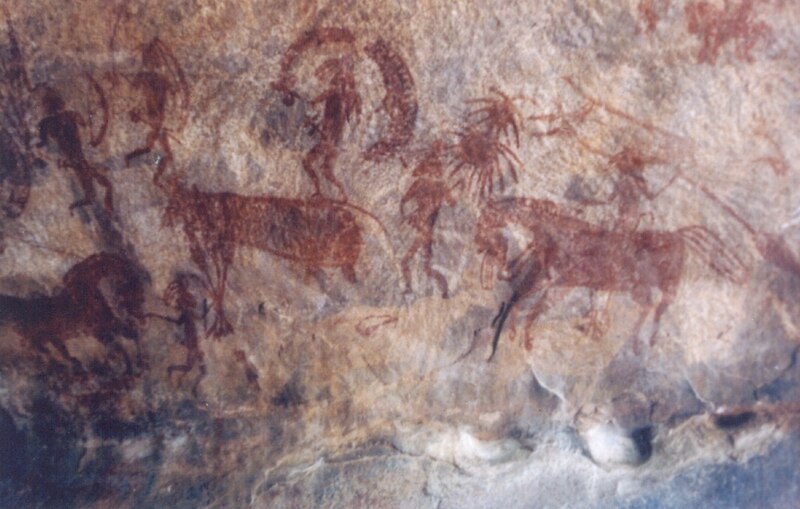
Isolated remains of Homo erectus in Hathnora in the Narmada Valley in central India indicate that India might have been inhabited since at least the Middle Pleistocene era, somewhere between 500,000 and 200,000 years ago.[3][4]
Tools crafted by proto-humans that have been dated back two million years have been discovered in the northwestern part of the subcontinent.[5][6] The ancient history of the region includes some of South Asia's oldest settlements[7] and some of its major civilizations.[8][9] The earliest archaeological site in the subcontinent is the palaeolithic hominid site in the Soan River valley.[10] Soanian sites are found in the Sivalik region across what are now India, Pakistan, and Nepal.[11]
The Mesolithic period in the Indian subcontinent was followed by the Neolithic period, when more extensive settlement of the subcontinent occurred after the end of the last Ice Age approximately 12,000 years ago. The first confirmed semipermanent settlements appeared 9,000 years ago in the Bhimbetka rock shelters in modern Madhya Pradesh, India.
Early Neolithic culture in South Asia is represented by the Mehrgarh findings (7000 BCE onwards) in present-day Balochistan, Pakistan.[12] Traces of a Neolithic culture have been alleged to be submerged in the Gulf of Khambat in India, radiocarbon dated to 7500 BCE.[13] However, the one dredged piece of wood in question was found in an area of strong ocean currents. Neolithic agriculture cultures sprang up in the Indus Valley region around 5000 BCE, in the lower Gangetic valley around 3000 BCE, and in later South India, spreading southwards and also northwards into Malwa around 1800 BCE. The first urban civilization of the region began with the Indus Valley Civilization.[14]

The history of India begins with evidence of human activity of Homo sapiens as long as 75,000 years ago, or with earlier hominids including Homo erectus from about 500,000 years ago. The Indus Valley Civilization, which spread and flourished in the northwestern part of the Indian subcontinent from c. 3300 to 1300 BCE, was the first major civilization in India. A sophisticated and technologically advanced urban culture developed in the Mature Harappan period, from 2600 to 1900 BCE. This Bronze Age civilization collapsed before the end of the second millennium BCE and was followed by the Iron Age Vedic Civilization, which extended over much of the Indo-Gangetic plain and which witnessed the rise of major polities known as the Mahajanapadas. In one of these kingdoms, Magadha, Mahavira and Gautama Buddha were born in the 6th or 5th century BCE and propagated their śramanic philosophies.
Almost all of the subcontinent was conquered by the Maurya Empire during the 4th and 3rd centuries BCE. It subsequently became fragmented, with various parts ruled by numerous Middle kingdoms for the next 1,500 years. This is known as the classical period of Indian history, during which India has sometimes been estimated to have had the largest economy of the ancient and medieval world, controlling between one third and one fourth of the world's wealth up to the 18th century.
Much of northern and central India was once again united in the 4th century CE, and remained so for two centuries thereafter, under the Gupta Empire. This period, witnessing a Hindu religious and intellectual resurgence, is known among its admirers as the "Golden Age of India". During the same time, and for several centuries afterwards, southern India, under the rule of the Chalukyas, Cholas, Pallavas, and Pandyas, experienced its own golden age. During this period, aspects of Indian civilization, administration, culture, and religion (Hinduism and Buddhism) spread to much of Asia.
The southern state of Kerala had maritime business links with the Roman Empire from around 77 CE. Islam was introduced in Kerala through this route by Muslim traders. Muslim rule in the subcontinent began in 712 CE when the Arab general Muhammad bin Qasim conquered Sindh and Multan in southern Punjab in modern day Pakistan,[1] setting the stage for several successive invasions from Central Asia between the 10th and 15th centuries CE, leading to the formation of Muslim empires in the Indian subcontinent such as the Delhi Sultanate and the Mughal Empire.
Mughal rule came from Central Asia to cover most of the northern parts of the subcontinent. Mughal rulers introduced Central Asian art and architecture to India. In addition to the Mughals and various Rajput kingdoms, several independent Hindu states, such as the Vijayanagara Empire, the Maratha Empire, and the Ahom Kingdom, flourished contemporaneously in southern, western, and northeastern India respectively. The Mughal Empire suffered a gradual decline in the early 18th century, which provided opportunities for the Afghans, Balochis, Sikhs, and Marathas to exercise control over large areas in the northwest of the subcontinent until the British East India Company gained ascendancy over South Asia.[2]
Beginning in the mid-18th century and over the next century, India was gradually annexed by the British East India Company. Dissatisfaction with Company rule led to the Indian Rebellion of 1857, after which India was directly administered by the British Crown and witnessed a period of both rapid development of infrastructure and economic decline. During the first half of the 20th century, a nationwide struggle for independence was launched by the Indian National Congress and later joined by the Muslim League. The subcontinent gained independence from the United Kingdom in 1947, after being partitioned into the dominions of India and Pakistan.


